15 Sep 2026
What actually happens to a sports hall floor
A sports hall floor does not wear out evenly. It wears out in the places people turn, stop and land, and it wears out under markings that were painted for a game the hall no longer hosts. By the time anyone rings us, the floor usually looks tired in a way nobody can point at precisely — dull in the middle, dark at the edges, and criss-crossed with three sets of lines in three colours, two of which are ignored.
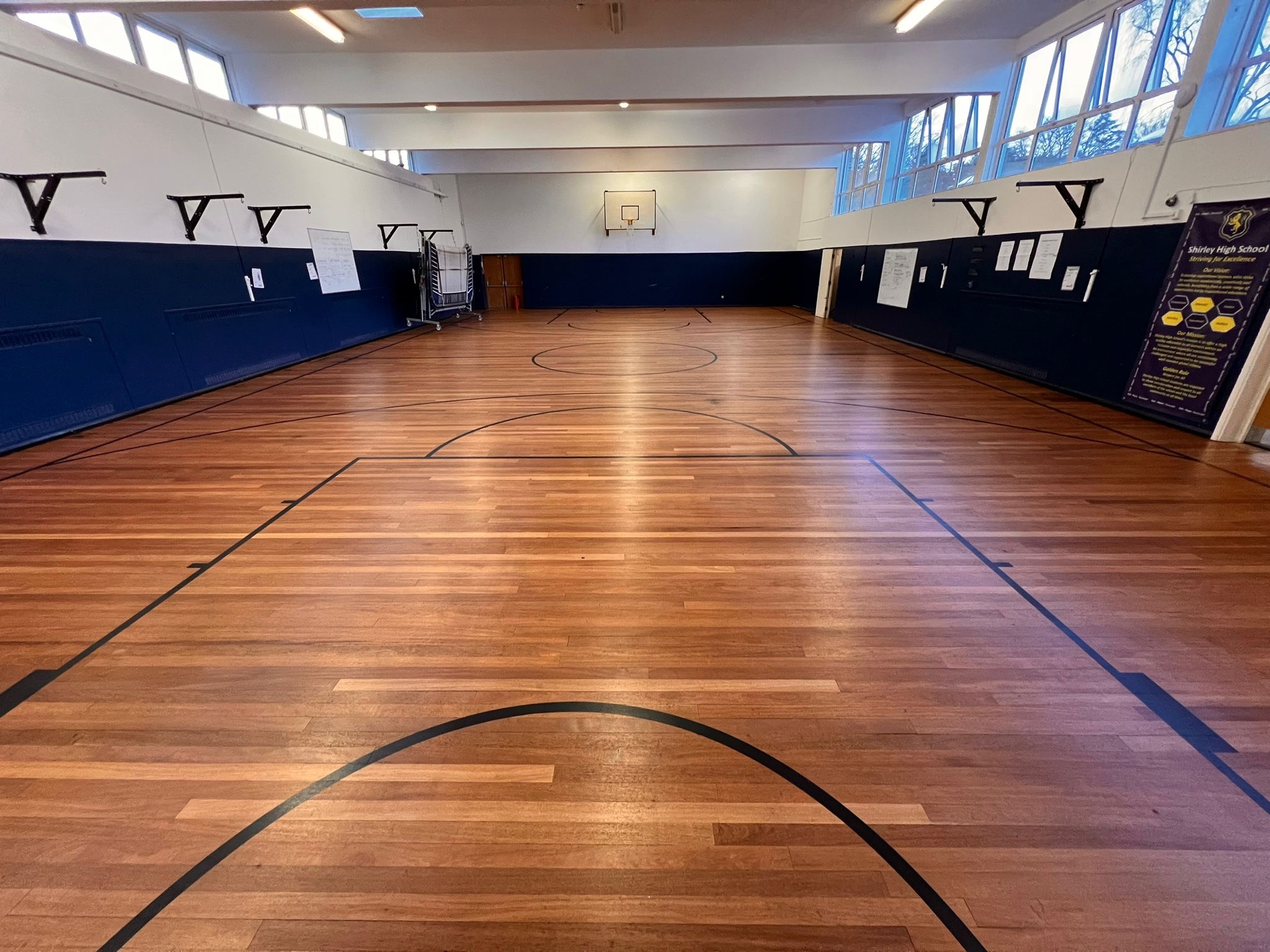
Here is what the work involves, using a recent secondary school hall in Croydon as the example. The photographs below are that floor, in order, with a second London hall for the line marking.
Stage one: everything comes off

The first pass takes off the old finish and the old markings together. You can see the belt sander working across the hall and the yellow and red lines still sitting in the timber ahead of it.
This is the stage that decides how the rest goes. Sports hall boards are usually thicker than domestic flooring, which is why a hall can be sanded several times across its life — but every hall has a limit, and the point of the first survey is to find out how much timber is left before anyone starts. A floor that has been sanded to the nail heads cannot be sanded again, and it is better to know that before the machines arrive than after.
Stage two: bare timber, and nothing to hide behind
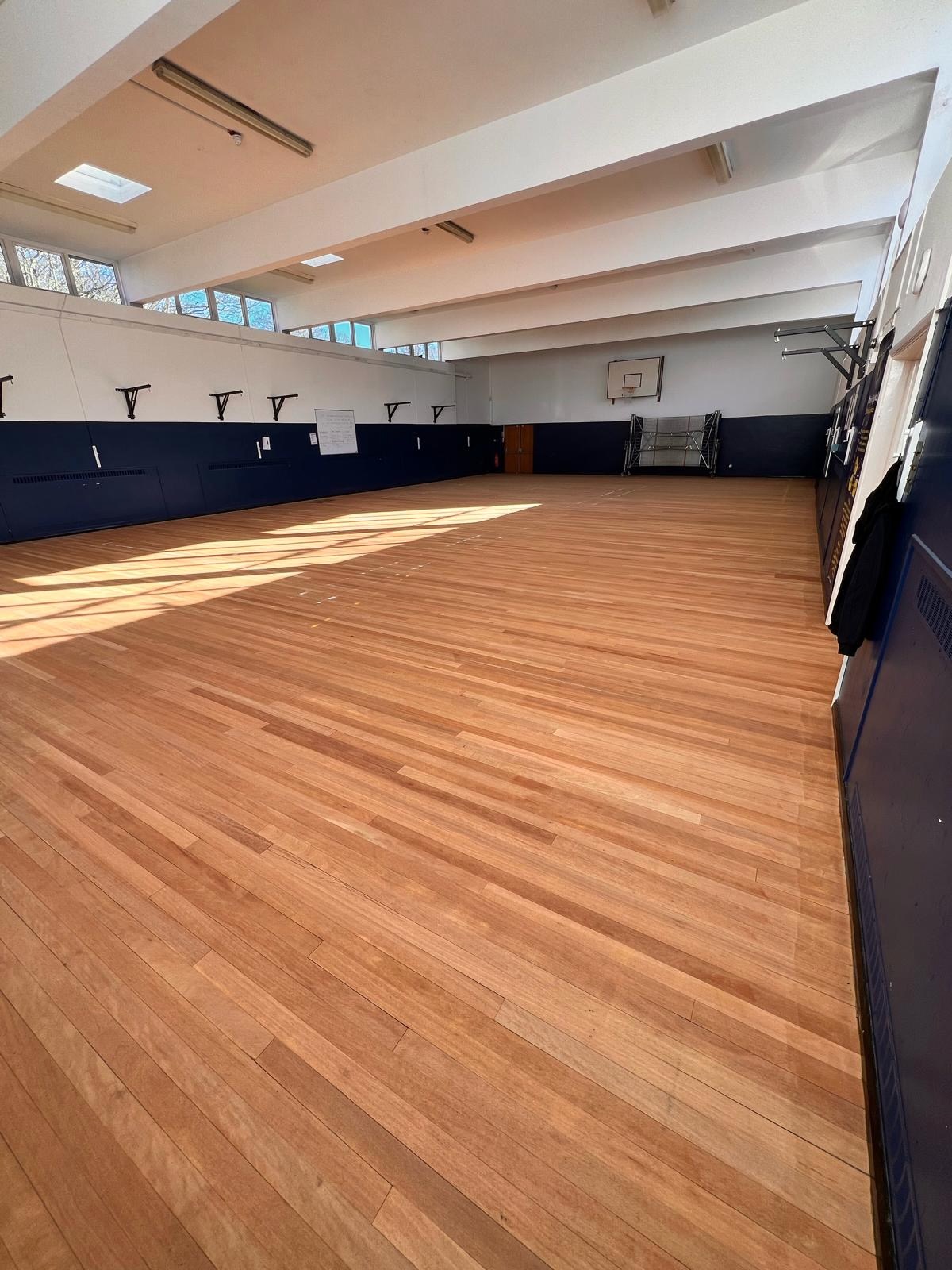
With the finish and the markings gone, the floor is one colour again. This is also the only moment when the timber can be inspected properly: damaged boards, gaps that have opened up, and any water damage around doorways are all visible now, and all easier to deal with now than under three coats of lacquer.
Halls are large, and large floors show every inconsistency. Most of the skill in this stage is in the joins between passes — where the machine lifts and sets down — because a ridge that is invisible on bare timber becomes a line of reflected light once the floor is sealed.
Stage three: sealing, then the lines
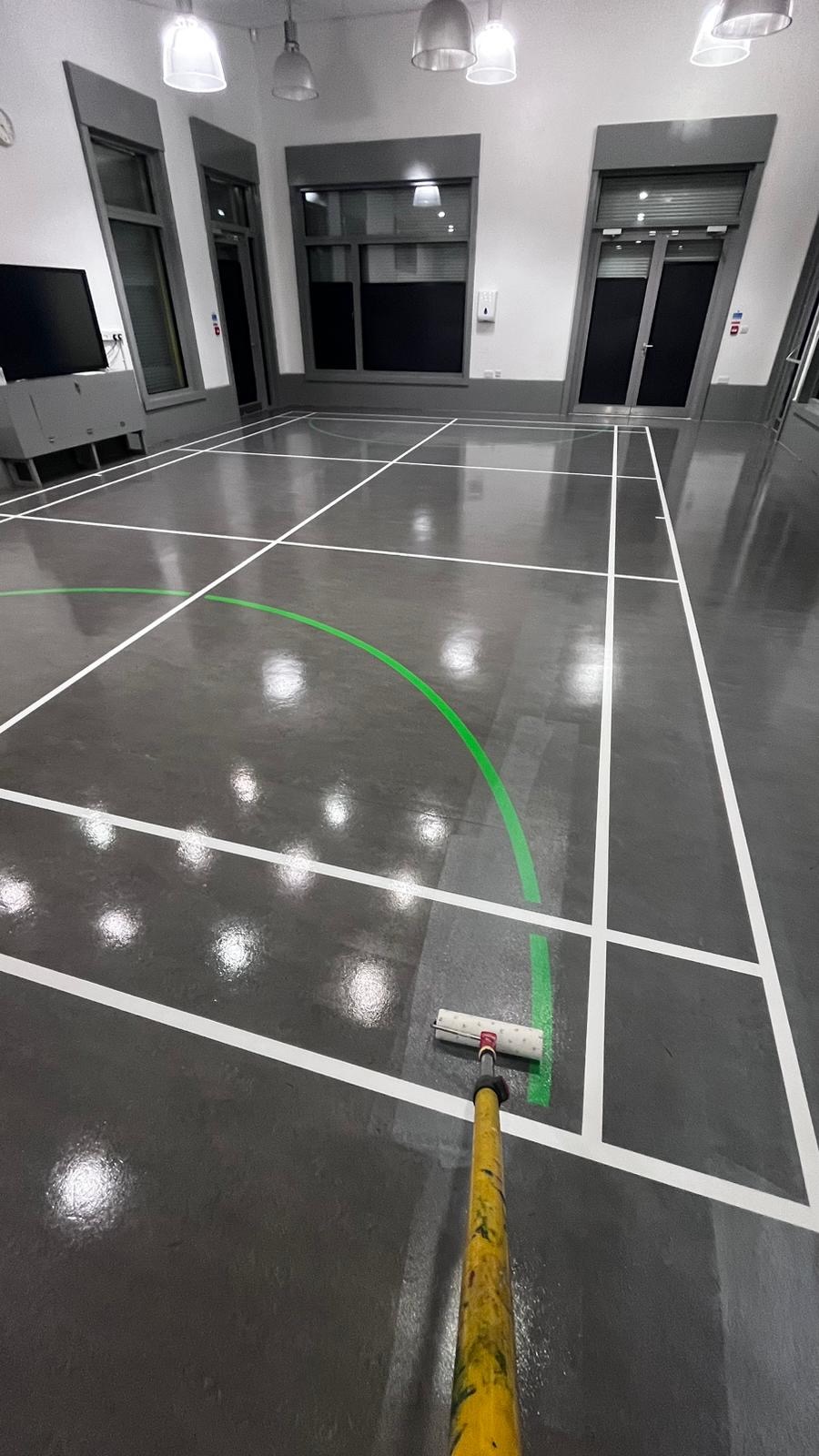
Markings go on after the first coats of lacquer, not before. Paint applied to bare timber soaks in and blurs; paint applied onto a sealed surface sits where it is put and keeps a clean edge. Each colour is set out, rolled on, and left to touch off before the next goes down. In practice the difference between a hall with one set of markings and a hall with four is small — it is not what decides how long the job takes.
The photograph above is a London hall mid-marking: the white lines are already down and a green line is being rolled in.
After the markings are finished, further coats of lacquer go over the top. That is what protects the paint — the lines are inside the finish, not on top of it, which is why they survive years of trainers rather than lifting at the edges.
Stage four: the floor the school gets back

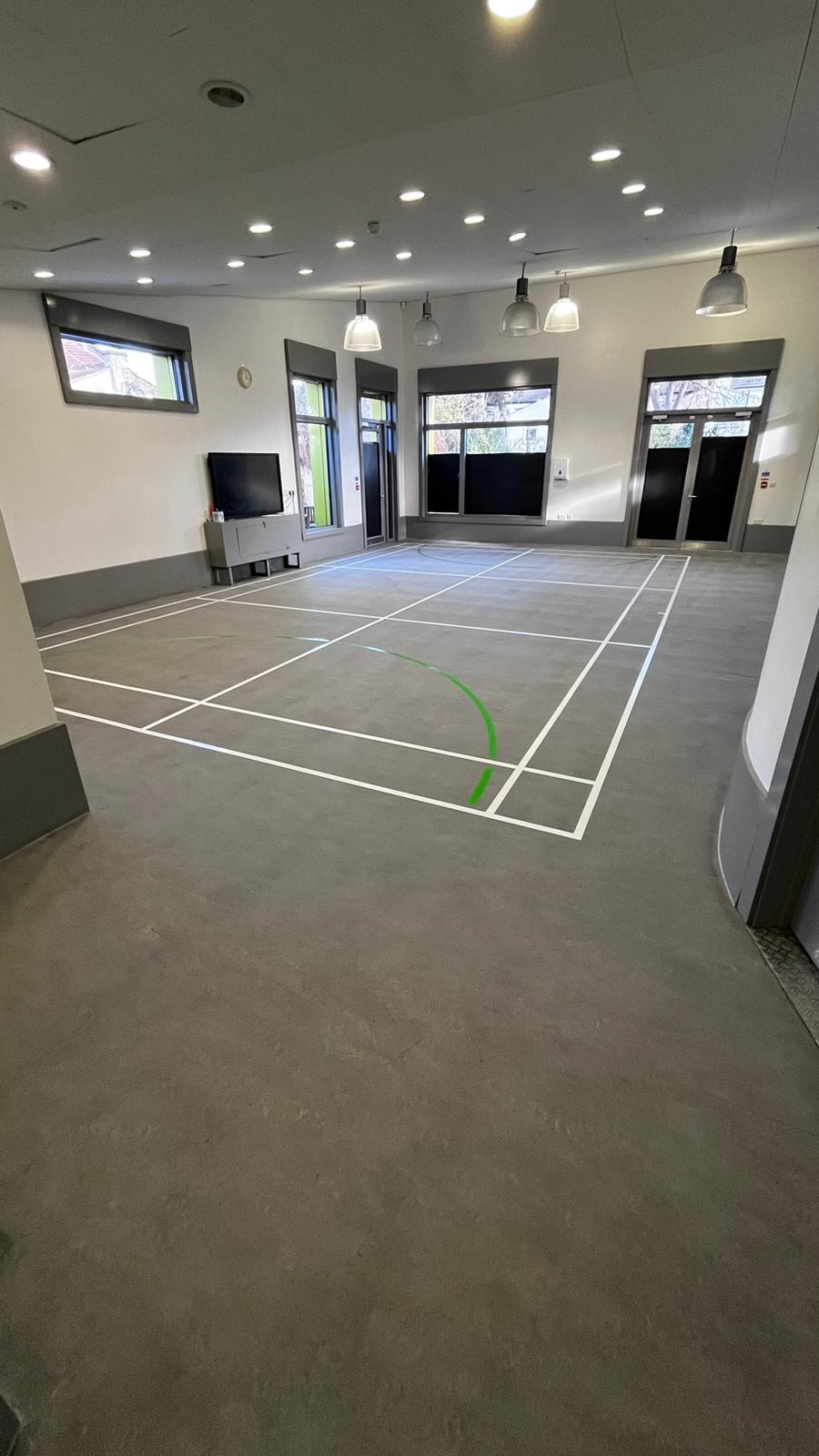
Two different halls, two different surfaces, two different finishes. The hardwood hall has its new markings under fresh lacquer. The second is a resilient floor — the sheet material most school halls are laid with — and it has been left matt, which shows fewer scuffs and fewer reflections under strip lighting.
Worth saying plainly, because the name above the door says sanding: **resilient floors are not a different trade for us.** Vinyl, LVT and the older resilient sheet in school halls all get wet sanded, sealed, marked out and finished, and the hall in these photographs is one of them. If your hall is not timber, it is still a floor we restore rather than one we would tell you to replace.
Matt or satin is worth a conversation before the work starts rather than after. A high-gloss hall photographs beautifully and then shows every mark within a term.
What tends to surprise people
Hard and cured are not the same date. A sports hall lacquer reaches full physical hardness within about 24 hours — the floor takes foot traffic and play from then on. What takes longer is the chemical cure — **seven to ten days** — and until that finishes the floor must not be mopped or wet-cleaned at all. Sweep it, use it, but keep water off it.
That is the constraint that decides scheduling, and it is why halls are usually done over a holiday rather than a weekend. A half-term break can be enough.
Dust: practically none, and it is worth saying what "practically" means. Modern sanding runs with extraction at the machine, and on a normal floor it is about as close to dust-free as the work gets. There will be trace amounts somewhere — in a corner, on a ledge — but not the kind that needs a special clean afterwards.
The exception is a floor that is badly out of level. A hall with humps and hollows takes more aggressive work to flatten, and more work makes more dust. That is worth knowing before the machines arrive, not after.
Line marking is a specialism. Setting out a court correctly is not a matter of measuring once. If the markings are wrong they are wrong under the lacquer, and putting them right means going back to bare timber.
If you are weighing this up
The useful first question is not what it costs. It is how much timber is left, because that determines whether the floor can be restored at all or whether you are budgeting for a replacement. A contractor who will not tell you that before quoting is guessing.